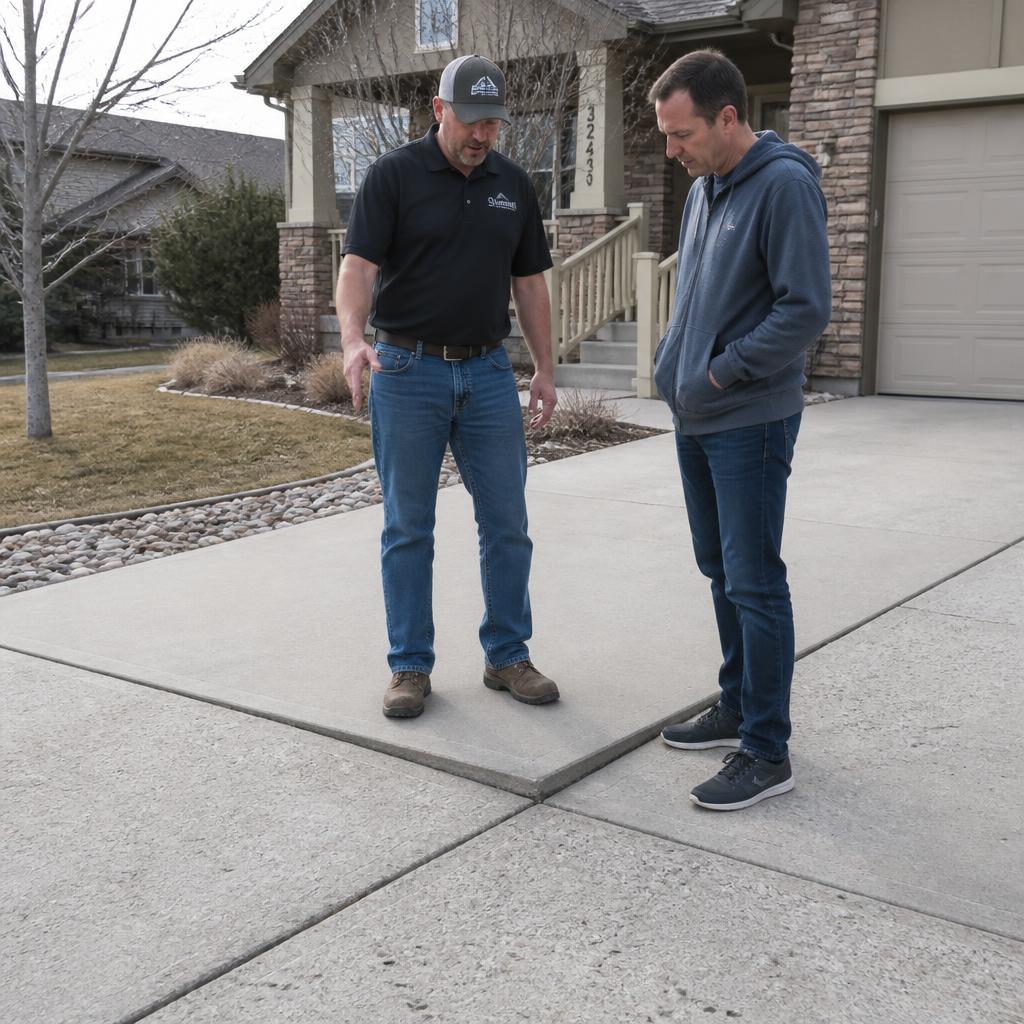
Most Colorado Springs homeowner's policies exclude damage from earth movement and gradual settlement — which is exactly what causes sunken driveways, sidewalks, and patios here. Here's what is and isn't covered, and how to think about the cost.
It's one of the first questions Colorado Springs homeowners ask after a driveway or patio starts to settle: *will insurance pay for this?* The honest answer, in almost every case, is **no — not directly.** Standard homeowner's policies are built to cover sudden, accidental damage. Concrete settlement caused by expansive clay and freeze-thaw is neither.
There are a few narrow exceptions worth knowing, and there are still smart reasons to document settlement carefully even when you can't file a claim. Here's how coverage actually works on the Front Range.
The Standard Answer: Earth Movement Is Excluded
Nearly every homeowner's insurance policy sold in Colorado carries an **earth-movement exclusion**. That single clause typically knocks out coverage for:
- Soil settling, sinking, expanding, or contracting (the mechanism behind almost all Colorado Springs settlement)
- Landslides and mudflow
- Sinkholes
- Earthquakes
- Damage from expansive clay swelling or shrinking
Since expansive Pierre shale clay is the primary reason concrete settles here — see how Colorado Springs expansive clay soil affects more than just concrete — the exclusion applies to the vast majority of sunken driveways, sidewalks, and patios along the Front Range.
Sudden and Accidental vs. Gradual Damage
The second filter insurers apply is whether the damage was **sudden and accidental** or **gradual**. Concrete settlement is almost always gradual — it happens over months or years as soil moisture cycles, drainage saturates the sub-base, or freeze-thaw slowly opens joints. Gradual damage of any kind is typically excluded, separate from the earth-movement clause.
This is why homeowners who assume 'the driveway cracked, so I have a claim' are often surprised. Insurers view the settlement as maintenance the homeowner is responsible for — much like a slowly leaking roof or a gradually failing water heater.
When a Claim Might Actually Apply
There are narrow scenarios where a claim can be viable. Each depends on your specific policy language, so always call your agent before assuming coverage.
1. A Sudden Plumbing Leak Under a Slab
If a service line, sewer lateral, or in-slab plumbing breaks and washes out the sub-base under a garage floor or patio, some policies cover the resulting concrete damage as **water damage from a sudden burst**, even though earth movement is excluded. The plumbing itself is often not covered; the resulting damage sometimes is.
2. A Vehicle Impact
A car that runs into a garage floor edge or drops off a settled apron and cracks the slab is a sudden accidental event. Auto coverage may apply; homeowner's may as well, depending on the circumstances.
3. Damage From a Covered Peril
If a covered peril — a hail-driven storm surge that overwhelms a downspout and undermines a slab, for instance — is the direct proximate cause, adjusters sometimes recognize the concrete damage. This is rare and always disputed. Documentation matters.
4. Additional Endorsements
Some Front Range carriers offer optional endorsements for sinkhole/earth-movement coverage or service-line coverage. They're uncommon on standard policies, and premiums vary widely. If you're in a neighborhood with known clay issues, ask your agent whether an endorsement is available and worth the cost.
What Won't Be Covered (Almost Always)
- A driveway that sank because a downspout dumped water against it for a decade
- A patio pulling away from the house due to expansive clay
- A garage floor settled from poor sub-base prep at original construction
- Sidewalk trip hazards from tree root uplift
- Any settlement that developed 'over time' rather than in a single event
If your situation looks like any of these, plan to treat the repair as an out-of-pocket homeowner expense. Our Colorado Springs concrete leveling cost guide covers realistic pricing ranges.
Should You File a Claim Anyway?
Usually, no. Filing a claim that gets denied still shows up on your loss history, and Colorado carriers do consider claim frequency at renewal. Two general guidelines:
- **Call your agent first**, before filing anything, and describe the damage honestly. They can tell you whether the situation has any chance of being covered.
- **Only file when there's a clear sudden covered peril** — a burst pipe, vehicle impact, or a storm event with documentation.
Why Documentation Still Matters
Even when insurance won't pay, it's worth documenting settlement carefully:
- **Dated photos** of the affected slabs from multiple angles
- **A simple measurement log** — how much lip at a joint, month over month
- **Notes on any triggering event** (a plumbing repair, an irrigation break, a heavy storm) in case coverage does apply
- **Contractor estimates** in writing for your records
This is the same documentation you'd use to decide whether to lift now or wait — see should you repair uneven concrete now or wait. And if you ever sell, this record shows a buyer's inspector that the issue has been monitored.
Practical Cost Perspective
For most Colorado Springs homeowners, the practical takeaway is that concrete leveling is a maintenance expense — like a roof repair or an HVAC service — not an insurance event. The good news is that lifting a settled slab typically costs a fraction of replacement, so the out-of-pocket number is often lower than homeowners fear. See concrete leveling vs. replacement for how those numbers compare.
Frequently Asked Questions
Does earthquake insurance cover concrete settlement in Colorado Springs?
Not typically. Earthquake endorsements cover damage from seismic events, not the day-to-day soil movement of expansive clay. Coverage for clay-driven settlement is very narrow, even on optional endorsements.
Will my policy pay if a plumbing leak undermined my garage floor?
It depends on whether the leak was sudden and accidental versus long-term. A pipe that burst overnight often qualifies for coverage of the resulting damage; a slow drip that failed over years usually doesn't. The plumbing itself is generally excluded either way.
Can I add settlement coverage to my policy?
A few Colorado carriers offer earth-movement or service-line endorsements. Availability and pricing vary widely along the Front Range. Ask your agent specifically about expansive-soil coverage — some endorsements exclude it even while they cover other earth movement.
What if my HOA is responsible for the sidewalk?
HOA-maintained sidewalks fall under the HOA's master policy and maintenance budget, not yours. See how HOA communities can manage uneven sidewalks and common areas for how those decisions are usually handled.
Final Thoughts
Most Colorado Springs concrete settlement is a maintenance issue, not an insurance issue. Understanding that up front lets you plan the repair on your timeline instead of waiting for a claim that isn't coming. When there's a real sudden event behind the damage, document it and call your agent before assuming anything.
If you'd like an honest assessment of what your settled slab would cost to lift, contact Colorado Springs Concrete Leveling for a free on-site walkthrough. Call 719-521-2291 or request an estimate online.
Related reading: Colorado Springs concrete leveling cost, concrete leveling vs. replacement, and how small concrete problems can become expensive repairs.